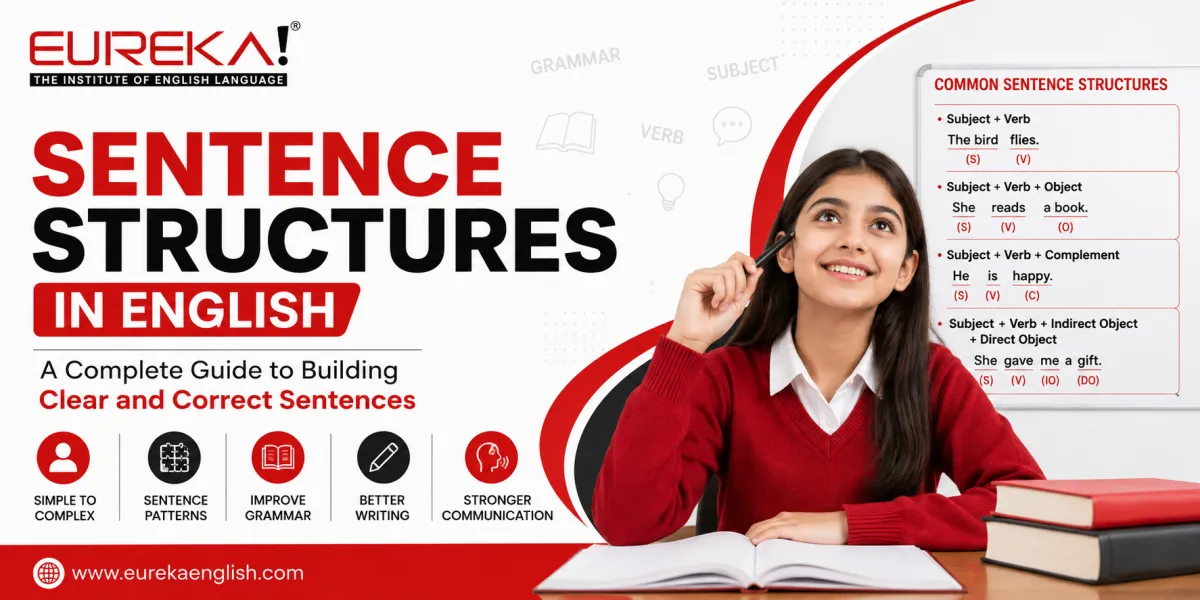
Sentence Structures in English: How to Build Clear and Correct Sentences
Introduction
Understanding sentence structures in English is one of the most important steps toward improving grammar, writing, and speaking skills. Many English learners know individual words and grammar rules but still struggle to put those words together correctly. Learning common sentence patterns makes it easier to express ideas clearly and communicate with confidence.
English sentences follow specific structures that determine how subjects, verbs, objects, adjectives, adverbs, and other words are arranged. Once you understand these patterns, you can create everything from simple everyday sentences to more advanced and detailed statements.
Whether you are a beginner, school student, or someone working to improve English communication, learning English sentence structure can provide a strong foundation for effective language learning.
What Are Sentence Structures in English?
Sentence structures in English describe how different parts of a sentence are organized to communicate a complete idea.
A basic English sentence usually contains a subject and a verb. Many sentences also include an object.
For example:
Sara reads books.
Sara = Subject
reads = Verb
books = Object
One of the most common patterns is:
Subject + Verb + Object (SVO)
Examples:
I learn English.
She reads books.
They play football.
We watch movies.
Understanding this basic structure makes English sentence formation easier for beginners.
The Main Parts of an English Sentence
Before learning different sentence patterns, it is important to understand the main components of a sentence.
1. Subject
The subject tells us who or what performs an action.
Examples:
Ali studies English.
The children are playing.
My teacher explains the lesson.
2. Verb
The verb describes an action, event, or state.
Examples:
study
speak
write
learn
play
is
become
3. Object
The object receives the action of the verb.
Example:
Ahmed reads a book.
Here, "Ahmed" is the subject, "reads" is the verb, and "a book" is the object.
4. Complement
A complement provides additional information about the subject or object.
Example:
She is happy.
"Happy" describes the subject "she."
5. Modifier
Modifiers provide additional information about a word or action.
Example:
He speaks English fluently.
"Fluently" tells us how he speaks English.
Basic Sentence Structures in English
There are several common sentence patterns in English that learners should understand.
1. Subject + Verb
This is one of the simplest structures.
Examples:
Birds fly.
Children laugh.
Students study.
He sleeps.
These sentences contain a subject and a verb and express a complete thought.
2. Subject + Verb + Object
This is one of the most commonly used structures.
Examples:
I study English.
She drinks water.
They play cricket.
We watch television.
This subject verb object structure is especially useful when learning basic English communication.
3. Subject + Verb + Complement
This structure connects the subject to additional information.
Examples:
She is happy.
He became a teacher.
The food looks delicious.
They are ready.
The complement describes or identifies the subject.
4. Subject + Verb + Indirect Object + Direct Object
Some sentences contain two objects.
Example:
She gave me a book.
Here:
She = Subject
gave = Verb
me = Indirect Object
a book = Direct Object
Other examples include:
He sent his friend a message.
My mother bought me a gift.
The teacher gave students homework.
Types of Sentence Structures
English sentences can also be categorized according to how many clauses they contain.
Simple Sentences
A simple sentence contains one independent clause.
Examples:
I like English.
She studies every day.
They play football.
Simple sentences are useful for beginners because they make communication clear and easy to understand.
Compound Sentences
A compound sentence combines two independent clauses using a coordinating conjunction such as and, but, or, so.
Example:
I wanted to study, but I was tired.
Another example:
She practices English every day, and she speaks confidently.
Compound sentences allow you to connect related ideas.
Complex Sentences
A complex sentence contains one independent clause and at least one dependent clause.
Example:
I practice English because I want to speak confidently.
Another example:
Although the lesson was difficult, the students continued practicing.
Complex sentences help learners express relationships such as reason, condition, contrast, and time.
Compound-Complex Sentences
These sentences combine features of compound and complex structures.
Example:
I practice English every day because I want to improve my fluency, and my brother practices with me.
These structures are more advanced and are useful when expressing multiple connected ideas.
How to Build Correct English Sentences
Learning English sentence formation becomes easier when you follow a simple process.
Step 1: Choose Your Subject
Decide who or what you are talking about.
I
Step 2: Add a Verb
Choose an appropriate action.
I learn
Step 3: Add an Object
Complete the basic idea.
I learn English.
Step 4: Add More Information
You can make the sentence more detailed.
I learn English every evening.
You can expand it further:
I learn English every evening because I want to improve my communication skills.
This step-by-step approach helps beginners build sentences without becoming confused by complicated grammar.
Common Sentence Formation Mistakes
English learners often make mistakes because they translate sentences directly from their first language or place words in the wrong order.
Incorrect Word Order
Incorrect: English I speak every day.
Correct: I speak English every day.
Missing Verb
Incorrect: She very happy.
Correct: She is very happy.
Subject-Verb Agreement
Incorrect: He speak English.
Correct: He speaks English.
Incorrect Question Structure
Incorrect: Where you are going?
Correct: Where are you going?
Understanding correct sentence structure can help you identify and avoid these common mistakes.
How Sentence Structure Improves English Speaking
Learning sentence structures is not only useful for writing. It can also improve your spoken English.
When you become familiar with common patterns, you do not have to construct every sentence word by word. Instead, you begin to recognize useful structures and use them naturally during conversations.
For example, learn the pattern:
I want + object
You can create:
I want some water.
I want a new book.
I want more information.
I want to improve my English.
Another useful pattern is:
I think + sentence
Examples:
I think English is important.
I think this idea is useful.
I think we should practice more.
Practicing these patterns can improve speaking speed, confidence, and fluency.
How to Practice Sentence Structures in English
Regular practice is essential for mastering sentence structures in English.
Try these activities:
Create Five Sentences Every Day
Choose a topic and create five sentences about it.
For example, if the topic is school:
I go to school every day.
My school is near my home.
I enjoy learning English.
My teacher explains grammar clearly.
I practice speaking with my classmates.
Expand Simple Sentences
Start with a basic sentence and gradually add information.
I read.
I read books.
I read English books.
I read English books every evening.
I read English books every evening to improve my vocabulary.
This exercise teaches you how to create longer sentences while maintaining correct structure.
Read and Identify Patterns
Read English articles, stories, or textbooks and identify the subject, verb, and object in different sentences. Then create your own examples using the same patterns.
Sentence Structures for Better English Communication
Understanding basic English sentence structure gives learners the confidence to communicate more effectively. Instead of focusing only on individual grammar rules, learners can understand how words work together to form complete ideas.
This is especially helpful for students who want to improve classroom participation, presentations, writing, and everyday conversations.
The goal is not to use complicated sentences all the time. Clear and simple sentences are often more effective than long sentences filled with unnecessary words.
As your grammar and vocabulary improve, you can gradually move from simple sentences to compound and complex structures.
Conclusion
Learning sentence structures in English provides a strong foundation for effective speaking and writing. By understanding the roles of subjects, verbs, objects, complements, and modifiers, learners can create clearer and more accurate sentences.
Start with basic patterns such as Subject + Verb and Subject + Verb + Object, then gradually learn compound, complex, and more advanced structures. Practice creating sentences every day, identify patterns while reading, and use new structures during conversations.
With consistent practice, you can improve English sentence formation, strengthen your grammar, and communicate your ideas more naturally and confidently.
Ready to improve your English fluency? Follow the Ultimate English Language Fluency Roadmap and build confident communication skills step by step.
Mastering basic English grammar is the first step toward confident communication. Practice sentence formation daily, strengthen your English sentence structure, and apply grammar in real conversations. For guided learning, explore our Certificate in Eureka Direct English (CEDE) and build a strong foundation for long-term English fluency.