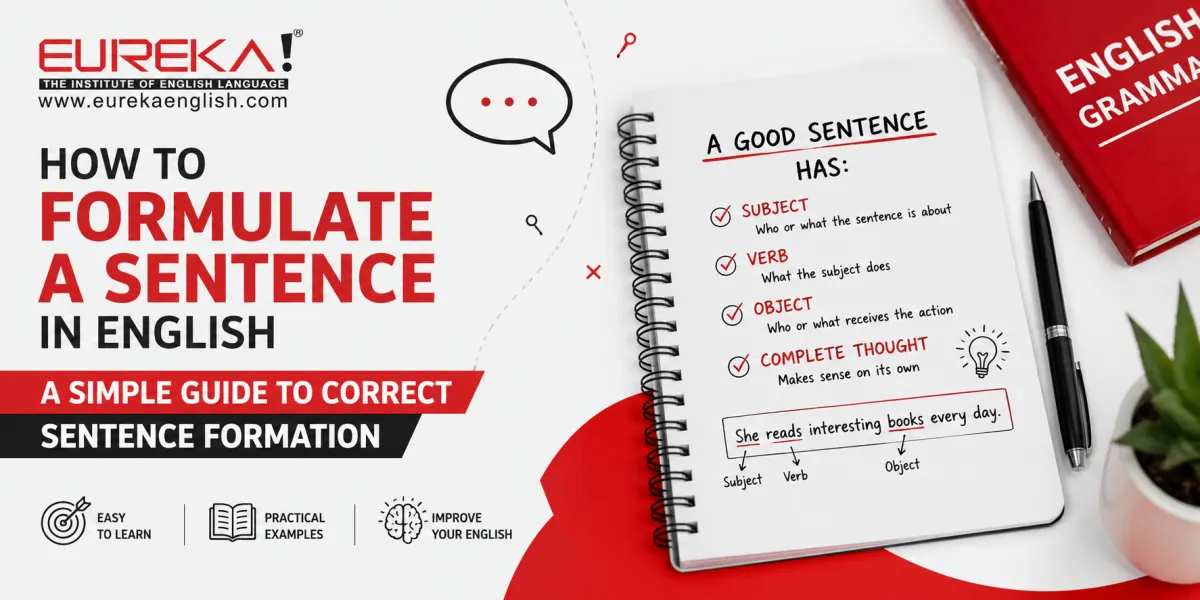
How to Formulate a Sentence in English: A Simple Guide to Correct Sentence Formation
Learning how to formulate a sentence is one of the most important skills for anyone learning English. You may know many English words and grammar rules, but if you do not know how to arrange those words correctly, it can be difficult to communicate your ideas clearly.
The good news is that English sentence formation follows several simple and predictable patterns. Once you understand the basic English sentence structure, you can create sentences for everyday conversations, academic writing, emails, presentations, and professional communication.
In this guide, we will explain how to formulate a sentence in English, explore common sentence patterns, discuss grammar rules, and provide practical examples for beginners.
What Does It Mean to Formulate a Sentence?
To formulate a sentence means to arrange words in the correct order so they communicate a complete thought or idea.
For example:
I learn English.
This sentence contains three important parts:
I – Subject
learn – Verb
English – Object
The basic structure is:
Subject + Verb + Object
This is one of the most common patterns used when learning how to make a sentence in English.
A correctly formulated sentence should generally have a clear meaning, appropriate grammar, and logical word order.
Basic Parts of an English Sentence
Before learning how to formulate sentences in English, it is helpful to understand the main parts of a sentence.
1. Subject
The subject tells us who or what performs an action.
Examples:
Ali studies English.
She reads books.
The students practice grammar.
2. Verb
The verb describes an action or state.
Examples:
learn
speak
read
write
study
play
become
Example:
They study English.
"Study" is the verb.
3. Object
The object receives the action of the verb.
Example:
She reads a book.
"She" is the subject, "reads" is the verb, and "a book" is the object.
4. Complement
A complement gives additional information about the subject or object.
Example:
He is a teacher.
"A teacher" gives information about the subject.
5. Adverb
An adverb can describe how, when, or where an action happens.
Example:
She speaks English confidently.
"Confidently" tells us how she speaks.
Understanding these parts makes English sentence formation much easier.
The Basic Sentence Structure in English
The most common English sentence structure is:
Subject + Verb + Object
Examples:
I read books.
She speaks English.
They play football.
We watch movies.
Ahmed studies grammar.
This structure is especially useful for beginners.
You can also create a sentence using only a subject and verb:
Birds fly.
Children laugh.
Students study.
The important thing is that the sentence should communicate a complete idea.
How to Formulate a Sentence Step by Step
If you are learning how to formulate a sentence, follow these simple steps.
Step 1: Choose Your Main Idea
First, decide what you want to say.
For example:
You want to talk about learning English.
Step 2: Choose the Subject
Ask yourself: Who is doing the action?
I
Step 3: Choose the Verb
What is the subject doing?
learn
Step 4: Add the Object
What is being learned?
English
Now you have:
I learn English.
Step 5: Add More Information
You can make the sentence more detailed:
I learn English every day.
You can expand it further:
I learn English every day to improve my communication skills.
This step-by-step method is an effective way to learn how to form a sentence in English.
Common Sentence Patterns
Learning different sentence patterns in English helps you create a wider range of sentences.
Subject + Verb
Examples:
Birds fly.
She smiled.
Children laughed.
Subject + Verb + Object
Examples:
I study English.
She reads books.
They play cricket.
Subject + Verb + Complement
Examples:
She is happy.
He became a teacher.
The lesson is easy.
Subject + Verb + Adverb
Examples:
He speaks clearly.
She works quickly.
They study regularly.
Practice these patterns until they become familiar.
How to Formulate Negative Sentences
Sometimes you need to explain that something does not happen.
For many present simple sentences, use do not or does not.
Examples:
I do not speak French.
They do not play tennis.
She does not like coffee.
He does not watch television.
Remember that after does not, the main verb stays in its base form.
Incorrect:
She does not speaks English.
Correct:
She does not speak English.
Understanding this rule is an important part of correct sentence formation.
How to Formulate Questions
Questions have a different structure from ordinary statements.
Statement:
You speak English.
Question:
Do you speak English?
Statement:
She likes reading.
Question:
Does she like reading?
You can also use question words such as:
What
Where
When
Why
Who
How
Examples:
What do you study?
Where do you live?
Why are you learning English?
How do you practice English?
Practicing questions can improve both grammar and English speaking skills.
Use Tenses Correctly
Knowing how to formulate a sentence also requires understanding basic verb tenses.
Present Simple
Use it for regular activities and facts.
I practice English every day.
Present Continuous
Use it for something happening now.
I am practicing English.
Past Simple
Use it for completed actions.
I practiced English yesterday.
Future Simple
Use it for future actions.
I will practice English tomorrow.
The tense you choose should match the time and meaning of your sentence.
Subject-Verb Agreement
One common problem in English sentence formation is incorrect subject-verb agreement.
For example:
I speak English.
But:
She speaks English.
With he, she, and it, the verb usually takes -s or -es in the present simple tense.
Incorrect:
He speak English.
Correct:
He speaks English.
Incorrect:
She work at school.
Correct:
She works at school.
Practicing this rule can help you formulate more accurate sentences.
Common Mistakes When Formulating Sentences
English learners often make mistakes because they translate directly from their first language.
Incorrect Word Order
Incorrect: English I speak every day.
Correct: I speak English every day.
Missing Verb
Incorrect: She very happy.
Correct: She is very happy.
Incorrect Verb Form
Incorrect: He go to school every day.
Correct: He goes to school every day.
Incorrect Question Structure
Incorrect: Where you live?
Correct: Where do you live?
Learning from these mistakes can significantly improve sentence construction in English.
How to Practice Sentence Formation
Knowing grammar rules is not enough. You need regular practice to become comfortable with how to formulate sentences in English.
Write Five Sentences Every Day
Choose a simple topic such as your daily routine.
For example:
I wake up early.
I have breakfast at home.
I go to school.
I study English in the afternoon.
I read a book at night.
Expand Your Sentences
Start with a simple sentence:
I read books.
Add more information:
I read English books.
Then:
I read English books every evening.
Finally:
I read English books every evening to improve my vocabulary.
This exercise helps you learn how to make sentences naturally.
Speak Your Sentences Aloud
Do not only write sentences. Say them aloud.
For example:
I am learning English because I want to speak confidently.
Speaking your own sentences helps connect grammar knowledge with real communication.
Tips for Formulating Better English Sentences
Follow these practical tips:
Start with simple sentence structures.
Learn the Subject + Verb + Object pattern.
Practice common English sentence patterns.
Pay attention to verb forms.
Check subject-verb agreement.
Learn basic tenses.
Read English regularly.
Write sentences every day.
Practice speaking aloud.
Gradually move from simple to complex sentences.
Do not try to memorize every grammar rule at once. Focus on one structure, practice it repeatedly, and then move to the next.
Conclusion
Learning how to formulate a sentence is an essential part of developing strong English grammar and communication skills. By understanding the subject, verb, object, sentence patterns, tenses, and basic grammar rules, you can create clear and meaningful sentences.
Start with simple structures such as Subject + Verb and Subject + Verb + Object. Then gradually practice questions, negative sentences, different tenses, and more advanced sentence patterns.
With regular English sentence formation practice, you can improve your grammar, writing, speaking, and overall English communication skills. The key is consistency: learn a structure, create your own examples, and use those sentences in real conversations every day.
Start your English learning journey today by exploring the Certificate in Eureka Direct English (CEDE) and build a strong foundation for English fluency.