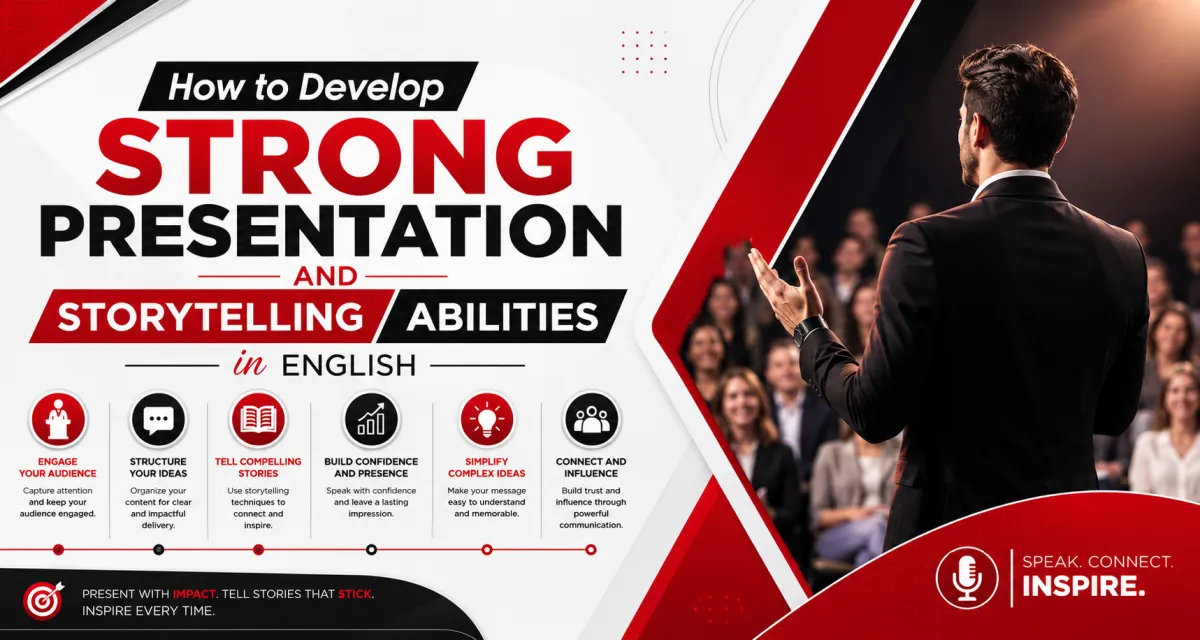
How to Develop Strong Presentation and Storytelling Abilities in English
Strong presentation and storytelling abilities are valuable communication skills in academic, professional, and everyday situations. Whether you are presenting an idea in a classroom, speaking in a business meeting, or explaining something to an audience, the ability to communicate clearly can make a significant difference.
For English learners, developing these skills can also improve confidence, fluency, and the ability to express ideas naturally. With regular practice and the right techniques, anyone can become a more effective English speaker and presenter.
What Are Presentation and Storytelling Abilities?
Presentation skills involve communicating information, ideas, or opinions clearly to an audience. Good presentation skills include clear speech, effective organization, confident body language, and the ability to keep listeners engaged.
Storytelling is slightly different. It involves presenting information through a structured story that helps the audience understand and remember the message.
Together, strong presentation and storytelling abilities can make communication more engaging and effective.
Why Are Strong Presentation Skills Important?
Presentation skills are useful in many areas of life. Students may need them for class presentations, while professionals may use them during meetings, interviews, training sessions, and business presentations.
Strong presentation skills can help you:
Communicate ideas more clearly
Speak with greater confidence
Keep an audience interested
Organize information effectively
Make a positive professional impression
Explain complicated ideas more easily
These skills become particularly important when English is not your first language.
How to Improve Your English Presentation Skills
1. Organize Your Ideas Before Speaking
A well-organized presentation is easier for both the speaker and the audience to follow.
Before presenting, divide your content into three basic sections:
Introduction: Explain the topic and tell the audience what they can expect.
Main Content: Present your key points in a logical order.
Conclusion: Summarize the main message and leave the audience with a clear final thought.
This simple structure can prevent your presentation from becoming confusing or repetitive.
2. Use Simple and Clear English
You do not need complicated vocabulary to sound professional. Clear and straightforward language is often more effective.
Instead of using long sentences, try to communicate one main idea at a time. Choose words that you understand well and can pronounce comfortably.
For example, instead of saying:
“It is imperative that organizations implement comprehensive strategies to facilitate effective communication.”
You could say:
“Organizations need clear strategies to improve communication.”
The second sentence is easier to understand while still communicating the main idea.
3. Practice Your Opening
The first few seconds of a presentation are important because they help establish the audience's attention.
You can begin with:
A question
An interesting fact
A short story
A surprising statement
A problem that your presentation will address
For example:
“Have you ever had a great idea but struggled to explain it clearly?”
This type of opening can encourage the audience to pay attention.
4. Use Storytelling to Make Your Message Memorable
Facts and information can sometimes be difficult to remember. Stories can make an idea more interesting and easier to understand.
A simple story structure can include:
A situation
A problem or challenge
An action
A result
A lesson or conclusion
For example, if you are giving a presentation about learning English, you could begin with a short story about someone who was afraid to speak English but gradually became confident through daily practice.
This gives your audience a relatable example instead of presenting information as a list of facts.
5. Use Your Voice Effectively
Your voice can have a major impact on how your presentation is received. Speaking at the same speed and tone throughout a presentation can make it difficult for listeners to remain engaged.
Try to vary:
Speaking speed
Volume
Tone
Pauses
Emphasis
A short pause before an important point can help attract attention and give the audience time to process what you are saying.
6. Improve Your Body Language
Communication is not only about words. Your posture, facial expressions, gestures, and eye contact can also influence how confident you appear.
Stand comfortably, keep your posture natural, and avoid constantly looking at the floor or your notes.
When speaking to an audience, try to make eye contact with different people instead of focusing on only one person.
7. Avoid Reading Your Entire Presentation
Reading every sentence directly from a screen or piece of paper can make a presentation sound less natural.
Instead, prepare short notes containing keywords and important points. This allows you to explain your ideas in your own words.
It also helps you develop the ability to think and speak in English rather than simply reading English.
8. Practice With a Timer
Time management is an important part of presentation skills. A presentation that is too short may not cover the topic properly, while one that is too long can lose the audience's attention.
Practice your presentation several times and use a timer. This will help you understand how long each section takes and where you need to make adjustments.
9. Record Yourself Speaking
Recording yourself is one of the most useful ways to identify areas for improvement.
When reviewing your recording, pay attention to:
Pronunciation
Speaking speed
Repeated words
Grammar mistakes
Voice clarity
Body language
Confidence
Pauses
You may notice habits that you do not recognize while speaking.
10. Practice Storytelling in Everyday English
You do not need an audience to practice storytelling. Choose a simple topic and tell a short story about it.
You could talk about:
A memorable trip
Your first day at school
A challenging experience
A favorite hobby
An important lesson you learned
A person who influenced you
Try to explain what happened, how you felt, and what you learned from the experience.
This type of practice can gradually improve your ability to organize thoughts and speak spontaneously in English.
Common Presentation Mistakes to Avoid
English learners often make a few common mistakes during presentations.
Speaking Too Fast
Nervousness can cause speakers to talk quickly. Slow down and use short pauses between important points.
Using Too Many Filler Words
Words such as “um,” “actually,” “like,” and “you know” can become distracting when used repeatedly.
Memorizing Every Sentence
Memorizing an entire presentation can make your speech sound unnatural. Focus on understanding your main points instead.
Ignoring the Audience
A presentation should feel like communication rather than reading. Look at your audience and pay attention to their reactions.
Overloading Slides With Text
Slides should support your presentation, not replace it. Use short points, headings, visuals, or key statistics rather than large blocks of text.
How English Learners Can Build Confidence
Confidence develops through practice rather than perfection. You do not have to wait until your English is perfect before speaking in front of others.
Start with short presentations. Speak for two or three minutes about a familiar topic, then gradually increase the length and complexity.
Practicing with classmates, friends, teachers, or language partners can also make the process easier.
If you want structured guidance to improve your speaking, presentation, and overall English communication skills, an English Speaking Institute in Karachi can provide a supportive environment for regular practice and learning.
Final Thoughts
Developing strong presentation and storytelling abilities takes consistent practice, but the benefits extend far beyond presentations. These skills can help you communicate ideas clearly, participate more confidently in discussions, perform better in interviews, and build stronger professional relationships.
If you want to improve your English speaking, presentation, and communication skills through structured learning, Eureka English can be a valuable option. With English-focused courses and practical learning opportunities, Eureka English helps learners build confidence and develop communication skills for academic, professional, and everyday situations.
With regular practice and the right guidance from Eureka English, learners can become more confident English speakers and develop the presentation and storytelling abilities needed to communicate their ideas effectively.