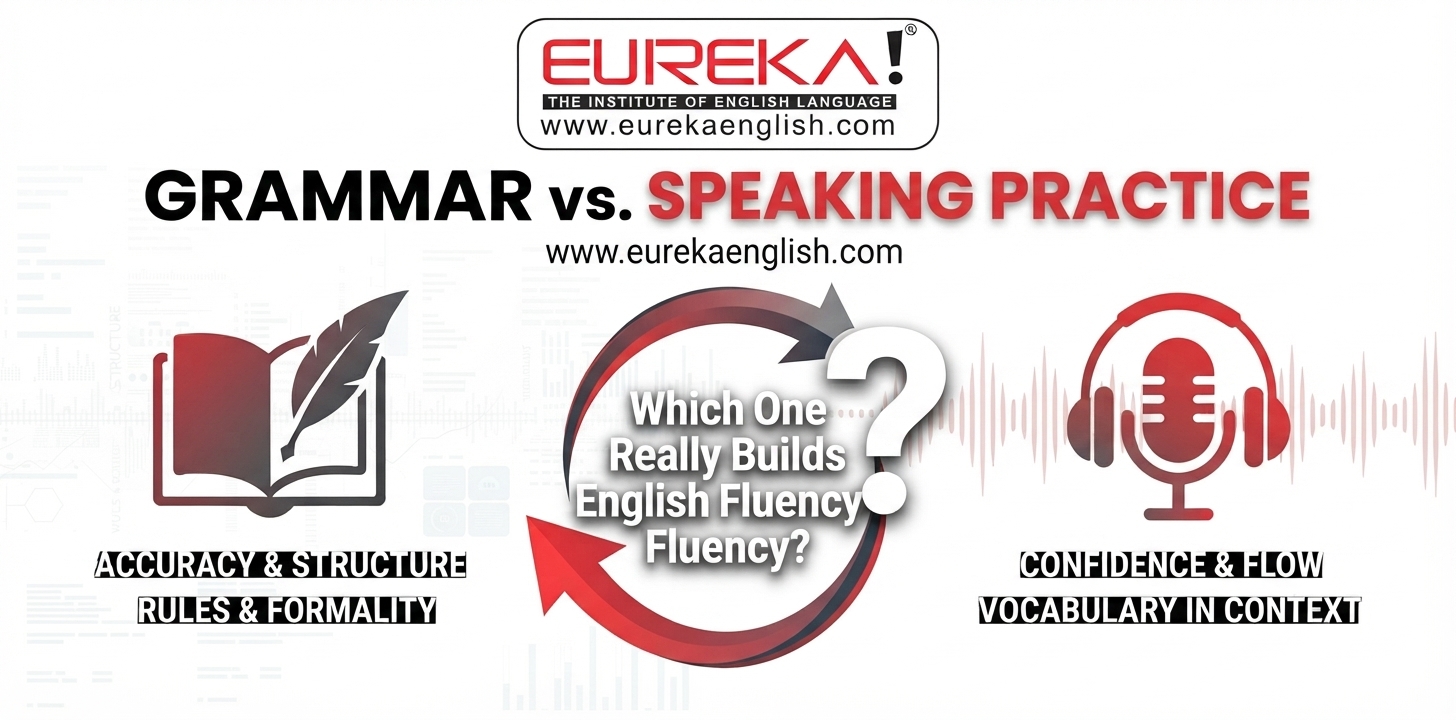
Grammar vs. Speaking Practice: Which One Really Builds English Fluency?
Grammar vs. Speaking Practice: Which One Really Builds English Fluency?
Learning English often creates a common question: Should you focus more on grammar or speaking practice? Many learners spend months memorizing grammar rules, verb tenses, and sentence structures but still struggle to speak confidently. Others start speaking immediately but make frequent grammatical mistakes.
The truth is that both grammar and speaking practice have a role in English language fluency, but they serve different purposes. Grammar gives you the structure to form accurate sentences, while regular speaking practice helps you use English naturally in real conversations.
So, when comparing grammar vs speaking practice, which one actually helps you become fluent? The answer depends on how you use each method.
What Is the Difference Between Grammar and Speaking Practice?
English grammar focuses on the rules that explain how words and sentences work together. Learning grammar can help you understand verb tenses, sentence formation, word order, articles, prepositions, and other important aspects of the language.
English speaking practice, on the other hand, focuses on actually using the language. It involves speaking with teachers, classmates, friends, colleagues, or even practicing aloud by yourself.
For example, knowing the rule for the present perfect tense is different from being able to use it naturally while talking about your experiences.
This is why grammar and speaking should not be treated as exactly the same skill. Grammar supports accuracy, while speaking practice develops fluency, confidence, and the ability to respond quickly.
Why Grammar Is Important for English Speaking
Grammar is an important foundation for effective communication. Without basic grammar knowledge, learners may find it difficult to create clear sentences.
For example:
“Yesterday I go market and buy some things.”
The listener may understand the meaning, but the sentence is grammatically incorrect.
With basic grammar knowledge, the learner can say:
“Yesterday, I went to the market and bought some things.”
This shows why grammar for English speaking matters. It helps you communicate ideas more accurately and avoid misunderstandings.
However, grammar knowledge alone does not automatically make someone fluent.
Grammar Helps You:
Build grammatically correct sentences
Understand how English sentences are structured
Use different verb tenses correctly
Improve writing accuracy
Reduce common speaking mistakes
Communicate more clearly
The problem starts when learners spend too much time studying grammar and too little time actually using English.
Why Speaking Practice Is Essential for English Fluency
If your goal is to speak English fluently, knowing grammar rules is only part of the process.
Fluency develops through repeated use. The more you practice speaking, the easier it becomes to retrieve vocabulary, form sentences, pronounce words, and respond during conversations.
Imagine learning how to ride a bicycle by reading instructions. You may understand every rule, but you still need to get on the bicycle and practice.
English works in a similar way.
You can memorize hundreds of grammar rules and still hesitate when someone asks you a simple question. Practice speaking English helps turn passive knowledge into an active communication skill.
Regular speaking practice can help you:
Respond more quickly
Think in English
Improve pronunciation
Build speaking confidence
Use vocabulary naturally
Reduce hesitation
Become comfortable with real conversations
This is why English fluency practice should be a regular part of your learning routine.
Grammar vs Speaking Practice: Which One Is More Important?
When comparing grammar vs speaking practice, speaking practice usually has a more direct impact on conversational fluency.
However, that does not mean grammar should be ignored.
Think of the two skills this way:
GrammarSpeaking PracticeBuilds accuracyBuilds fluencyTeaches language structureTeaches practical usageHelps reduce grammatical errorsHelps reduce hesitationSupports sentence formationBuilds speaking confidenceUseful for writing and formal EnglishEssential for conversations
A learner who only studies grammar may understand English but struggle to use it spontaneously.
A learner who only speaks without learning any grammar may become comfortable communicating but continue making repeated mistakes.
The most effective approach combines both.
Can You Become Fluent Without Perfect Grammar?
Yes. You do not need perfect grammar before you start speaking English.
Many learners make the mistake of waiting until their grammar is perfect before having conversations. This creates fear of making mistakes and slows down progress.
Fluency is not the same as grammatical perfection.
If you can communicate your ideas clearly, understand others, respond naturally, and continue a conversation, you are developing practical fluency.
Of course, improving grammar will make your communication more accurate. But you should learn grammar while actively using English rather than treating grammar mastery as a requirement before speaking.
How Much Grammar Is Needed to Speak English?
You need enough grammar to create understandable and reasonably accurate sentences. You do not need to memorize every grammar rule.
Beginners should first focus on practical areas such as:
Basic sentence structure
Present, past, and future forms
Subject-verb agreement
Questions and negatives
Common prepositions
Articles
Modal verbs
Everyday sentence patterns
Once you understand these basics, spend more time applying them through English conversation practice.
For example, after learning the past tense, don't just complete grammar exercises. Talk about what you did yesterday.
Instead of writing:
I visited my friend.
I watched a movie.
I cooked dinner.
Practice saying:
“Yesterday, I visited my friend. We watched a movie together, and later I cooked dinner.”
This connects grammar knowledge with real communication.
Why Speaking Practice Improves Fluency Faster
Speaking requires your brain to perform several tasks at the same time. You need to understand the question, find the right vocabulary, create a sentence, pronounce the words, and respond quickly.
Repeated practice makes this process more automatic.
At first, you might translate sentences from your native language before speaking English. With consistent practice, common expressions and sentence patterns become easier to recall.
This is one reason how to improve English fluency is not simply a grammar question. Fluency requires active language use.
Try These Speaking Activities
1. Speak for One Minute
Choose a simple topic such as your daily routine, favorite food, or weekend plans. Speak continuously for one minute.
2. Describe What You See
Look around your room and describe objects, actions, and surroundings in English.
3. Practice Questions and Answers
Prepare common questions and answer them aloud instead of only reading the answers.
4. Retell a Story
Read or listen to a short English story and explain it in your own words.
5. Record Yourself
Record your speaking and listen for pronunciation, grammar, vocabulary, and hesitation.
These activities provide practical English speaking practice without requiring a conversation partner every time.
The Best Approach: Combine Grammar With Speaking
Instead of choosing between grammar and speaking, combine them.
A simple learning cycle can look like this:
Learn → Practice → Speak → Correct → Repeat
For example, suppose you learn how to use the past tense.
First, understand the basic grammar rule. Then complete a few examples. After that, use the tense while talking about your previous day. Identify your mistakes and try again.
This approach helps transform grammar knowledge into spoken English skills.
A Simple Grammar and Speaking Practice Routine
You can create a daily routine that gives both skills enough attention.
15 Minutes: Grammar
Learn one small grammar concept instead of trying to memorize many rules at once.
20 Minutes: Vocabulary
Learn useful words and phrases related to your everyday life.
20 Minutes: Speaking
Use your new grammar and vocabulary in sentences and conversations.
10 Minutes: Review
Listen to your recording or review mistakes from your practice session.
Even a short daily routine can make a difference when you practice consistently.
Focus on Communication, Not Perfection
One of the biggest barriers to English speaking skills is the fear of making mistakes.
Learners often think:
“What if my grammar is wrong?”
“What if I pronounce a word incorrectly?”
“What will people think about my English?”
These thoughts can prevent you from speaking.
Instead, focus first on communicating your message. Notice your mistakes, learn from them, and try again.
Mistakes are a normal part of English language learning. Every speaking attempt gives you an opportunity to improve.
Grammar Gives You Accuracy, Speaking Gives You Fluency
The debate between grammar and speaking practice does not need to have a winner.
Grammar helps you understand how English works. Speaking practice teaches you how to use that knowledge in real situations.
If your goal is to improve spoken English, don't spend all your learning time memorizing grammar rules. Learn the essential grammar concepts and immediately put them into practice.
The key is balance.
Grammar can help you speak correctly, but speaking practice helps you speak naturally.
For learners who want stronger English communication skills, the most effective strategy is to combine grammar, vocabulary, pronunciation, listening, and regular conversation practice.
Final Thoughts
So, grammar vs speaking practice: which one really builds English fluency?
The answer is simple: both matter, but speaking practice is what turns language knowledge into real-world fluency.
Grammar gives you the structure. Speaking gives you experience. Grammar can explain why a sentence is correct, while speaking practice helps you produce that sentence naturally when you need it.
If you want to speak English fluently, don't wait until your grammar is perfect. Start speaking, make mistakes, learn from them, and keep practicing.
The goal of learning English is not simply to know more rules. It is to confidently use English to communicate your thoughts, ideas, and experiences.
If you're serious about improving your communication, choose a structured learning program that focuses on practical conversations rather than memorization. The Certificate in Eureka Direct English (CEDE) is designed to help beginners develop vocabulary, grammar, pronunciation, and real-world speaking skills through a step-by-step learning framework.